How long do you need to train for climbing? Elite climbers miss more sessions than you think
There's a narrative in training culture that consistency means perfection - never missing a session, never breaking the streak, never falling off the plan. I have personally shouted the mantra of 'consistency is king' and seen many many apps out there that rewards frequency over all other metrics. The data from 6,500 coached climbers challenges this narrative directly.
I measured two dimensions of training behaviour. First, week-to-week consistency: the percentage of total weeks where a climber logged at least one training session. Second, total duration: how many weeks they remained active on the platform, committed to a plan and working with a coach.
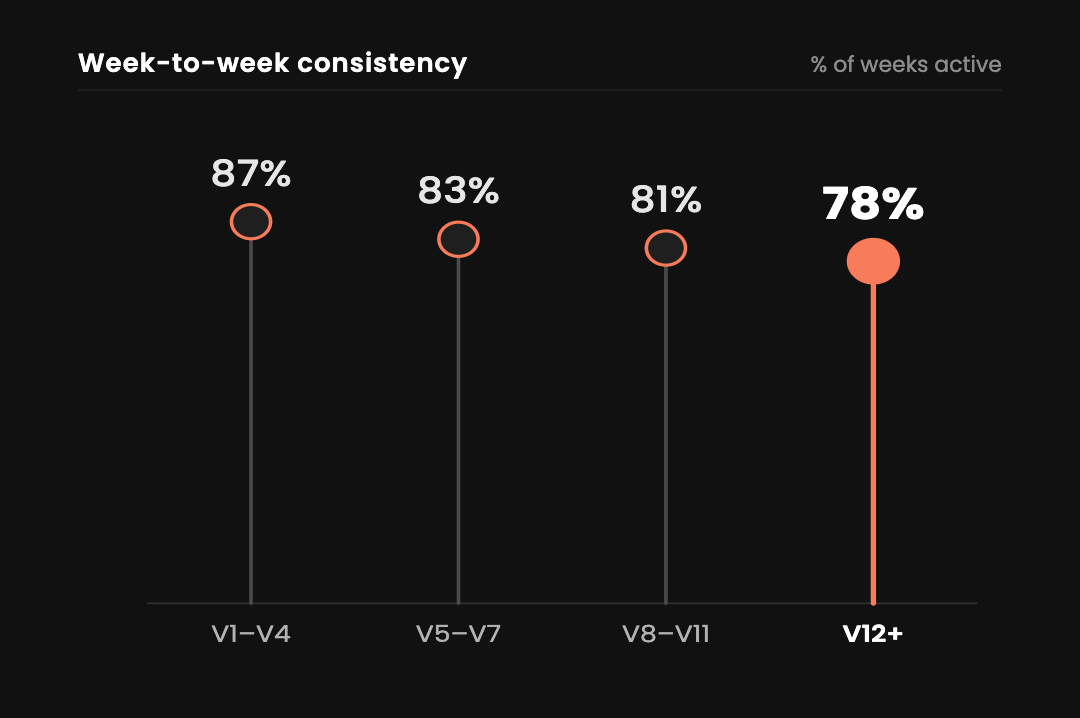
The consistency numbers are surprising.
V1-V4 climbers show 87% week-to-week consistency - the highest of any group. V5-V7 drops to 83%. V8-V11 to 81%. And V12+ climbers? Just 78%. The strongest climbers in our dataset are the least consistent on a week-to-week basis.
But the duration numbers tell the real story.
V1-V4 climbers average 27 weeks committed to a plan and coach. V5-V7 average 38 weeks. V8-V11 average 51 weeks. And V12+ climbers average 60 weeks - more than double the beginner cohort.
The maths is simple: 78% of 60 weeks (47 active weeks) beats 87% of 27 weeks (23 active weeks) by more than 2:1. Elite climbers accumulate roughly twice as many total training weeks despite having a lower percentage of active weeks.
Why are elite climbers less consistent?
Several factors likely contribute.
Firstly, life is more likely to get in the way over longer timeframes - injuries, travel, work demands, family obligations. However, this consistency finding did hold steady when we normalised time periods, so this can only play a small part.
Stronger climbers also tend to periodise more aggressively, incorporating planned complete deload weeks and full rest phases that show up as 'missed' weeks in the data.
Lastly and most importantly, climbers who've been training for years have learned that missing a week isn't catastrophic. It’s okay to miss some training and then get back to it. As better climbers have a more established base, they may also find less of a detriment to performance by taking some time off.
This finding has profound implications for how we should think about training adherence.
All media glorifies the optimised structured lifestyle these days and sport is no different. But the data suggests that this kind of rigidity may actually be counterproductive to long-term gains. The climbers who reach the highest grades are the ones who develop a sustainable, long-term relationship with training - one that accommodates life's interruptions.
My practical advice? Stop optimising for perfect consistency. Start optimising for longevity. That means, pick training you enjoy and do it at a frequency that is sustainable. A training plan you can maintain for 60 weeks at 80% adherence will produce better results than one you follow perfectly for 27 weeks before burning out.
Show up when you can. Rest when you need to. And make sure to enjoy what your doing.
Ready to commit to the long game? A LatticePlan gives you structured, periodised training that adapts when life gets in the way. Try it free for 7 days and see what sustainable training actually looks like.
Comments (1)
 MH
MHManuel Hörner
·
June 26, 2026
This is a great article. I would also love to see the Kaplan-Meier graphs from the persistence analyses. Is there also an analysis of intra-week variability? For example, whether someone spontaneously shifts a training session planned for Monday to Thursday, or vice versa? I would be interested in developing this into a scientific article (A comparison with therapies in breast cancer might be interesting, though far-fetched). Please feel free to contact me by email.