The average V12+ climber in one of our largest datasets (65,000 climbers) has been climbing for the same amount of time, and the number, might suprise you.
Looking through our data this week, I decided I would inspect one of our largest datasets which gave me the opportunity to see if there’s any patterns in how long elite level climbers (V12+) have been climbing and training for. I was interested in this particular question as I’ve worked with so many climbers over the last decade that have elite-level aspirations and I know intuitively that each path is going to have quite a different trajectory. However, I’ve never looked at the data to put an actual number on it, so here’s what I found.
The headline finding from our data is fairly striking: the average V12+ climber has been climbing for 11.8 years and training for 6.5 of them. In a world of rapid-results marketing and Instagram monsters hitting V12 in just a few years, the data immediately cautions us to be a little more patient. Elite performance generally, takes time and lots of it.
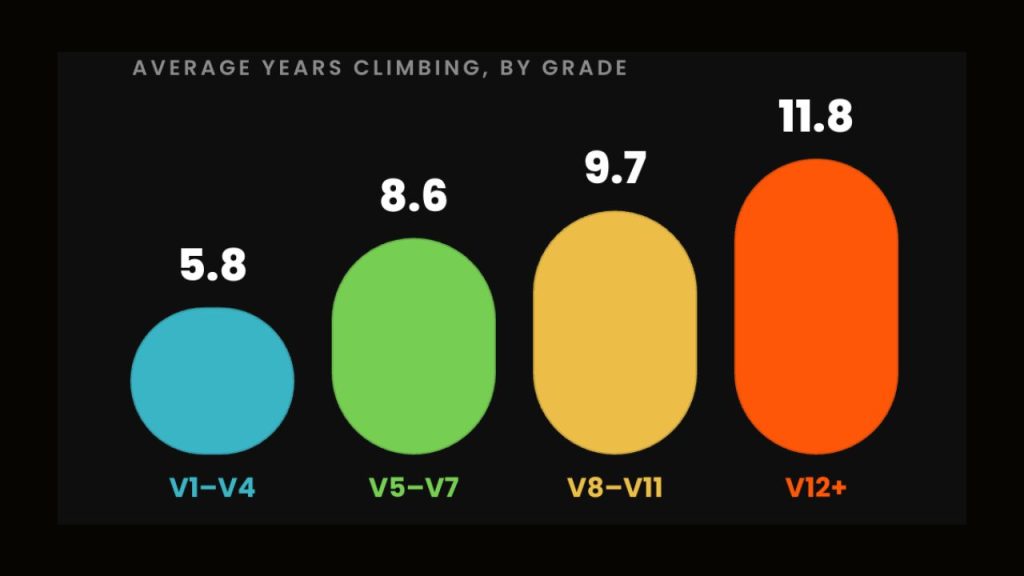 The progression at lower grades follows a similar pattern, but slightly scaled down. V1-V4 climbers average 5.8 years on the wall with 2.4 years of training (although note my caveat at the end on this one). V5-V7 climbers report 8.6 years climbing with 3.2 years of structured work. V8-V11 climbers at 9.7 years climbing and 4.6 years training. The trend is obvious: each grade band demands more accumulated time, which I think very few of you will have argued against.
However, when we split the V12+ data by age, the "12 years" average unsurprisingly moved significantly either way.
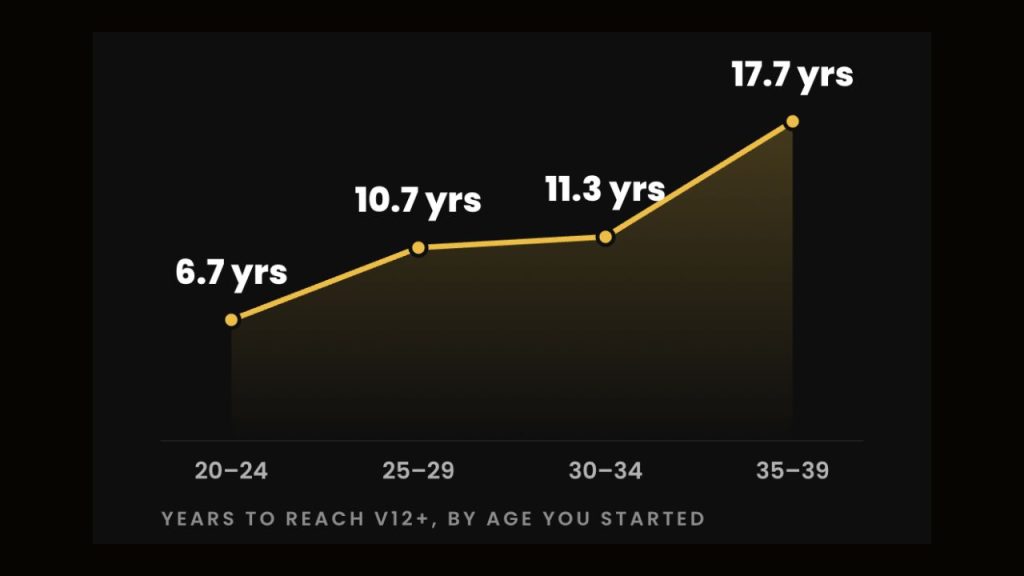
Climbers currently aged 20-24 who boulder V12+ report just 6.7 years of climbing experience - roughly half the overall average. The 25-29 group needed 10.7 years (still quite early starters though!). The 30-34 group is at 11.3 years, close to the overall average. And the 35-39 cohort needed a big commitment of 17.7 years - nearly three times longer than the youngest group.
This pattern isn't confined to V12+. Across every grade from V4 to V13, older climbers consistently report more years of experience to reach the same level. At V8, under-25s average 3.8 years while 40+ climbers average 13.0 years. The gap extends as the grades get harder.
 ---
---
Why? And how does this affect you?
Firstly, we need to be aware that several factors compound to affect the results. Younger climbers benefit from faster recovery, bodies that are developing whilst also being trained, greater neuroplasticity and started during a critical window of excellent “training ROI” in terms of physical development. Many in the 20-24 cohort also began climbing as teenagers. Both of these groups arguably benefit from more spare time to climb, lower allostatic load and fewer financial responsibilities. Older climbers juggle training with careers and making ends meet, families and social lives, and the realities of ageing physiology. There's also a survivorship effect - the 35-year-olds climbing V12+ are a self-selected group who persisted for nearly two decades and the data in this case wasn’t analysed for when they first gained their V12s and beyond.
One of the main takeaways I believe is useful to takeaway from this article is that elite climbers have spent over half their time (55%) involved in structured training, regardless of age. The ratio of training-to-climbing years matters more than the raw number of either.
The practical takeaway? A 22-year-old and a 37-year-old both aspiring to V12 are on fundamentally different timelines if they’ve both only been climbing for 5 years. Setting expectations based on the overall "12 years" average could discourage older climbers who may need 15+ years, or underwhelm younger climbers who might get there in much less.
That also brings me to the caveat I mentioned earlier. My hunch is that when we look at the data, the lower end grade group of V1-4 over reports on climbing years and training years as I suspect that this group, as a whole, contains less climbers focused on performance and more of those who wish to retain longevity in the sport, reduce injury rate or simply increase their tolerance for load so they can have bigger days out. As I said, though, it’s just the hunch of an experienced coach. I don’t have data on this one!
Data or not, the message from me remains the same as many other articles I write here: climb consistently, train with purpose and trust the process. How much time takes to reach your grade goals depends heavily on when you started. The best time to start training, is early on in your climbing journey. The second best time is now - whatever your age.
Whether you're 6 months in or 16 years deep, structured training accelerates the journey and improves the results at the end. A LatticePlan works for you wherever you are in your journey.
Try it free for 14 days and start making every month of climbing count.
Comments (0)
Be the first to leave a comment.