Finger Strength For Climbers Increases, In Relation To Grade
If you could only improve one thing to climb harder, what should it be? Finger strength for climbers is long considered important, but many believe skill or technique to be a bigger piece of the puzzle. Whatever your answer, I think you’ll find our data analysis below interesting and useful for your own journey.
In the particular cleaned data set that I recently analysed, we’d tested over 6,000 climbers across the full grade spectrum. We measured everything from finger strength and pull-ups to flexibility and antagonist strength like push-ups. The answer was decisive: finger strength is massively critical for climbing performance and highly correlated to it across the entire grade spectrum. We’ve recently published an Instagram post if you’d like to see more on that correlation, see here.
On 2-arm hangs, climbers in the V1-V4 range added an average of 19.0kg to their bodyweight on max efforts. By V5-V7, that rose to 24.2kg. The jump to V8-V11 saw 38.4kg added, which is significantly more than the beginner level. And at V12+, the average climber hangs with an additional 52.9kg. Nearly triple what they were hanging, on average, as they started on their climbing journey! You might also be wondering about those pull-ups and press-ups I mentioned a second ago. Pull-ups double. Press-ups, interestingly, barely changed. Don’t let that fool you into thinking they don’t matter at all though… More on that later.
But when we split the data by gender, a bigger (and more complex) picture emerged. We kept it simple with male vs female recorded data.
Male climbers showed a 2.6x increase. The progression is steep but consistent. It is also a grade progression that technique alone cannot bridge. Also more on that later.
Female climbers told a slightly different story. They started from +6.6kg at V1-V4 and finally values increased to +29.5kg at V12+. That's a 4.5x increase - nearly double the relative increase seen in males. Importantly, you’ll note that whilst relative increases are greater, the absolute metrics generated by female climbers remained lower (one obvious factor being that mass is significantly lower across the entire cohort).
What do I take from this and how does Lattice as a whole, advise on finger strength training across all climbers?
Right from the start, when myself and Tom started assessing and training climbers we noted that one 9a climber - or for that matter, a V14 boulderer - was not necessarily producing the same finger strength metrics as another 9a climber, despite the fact they climbed the same grade. As we collected more data over the years we noticed two main patterns. Firstly that female climbers generally produced quite different metrics to their male counterparts and secondly that even within a selected gender’s collection of data there was a spectrum of finger strength results which on the whole showed a normal bell-shaped curve of distribution.
This led us to broaden our testing metrics and data models to cover more varied tests and the models to become multi-factorial so that we could hone in on ‘better’ training conclusions based on things like gender, height, upper body conditioning, flexibility and other factors like years of climbing and how many days of climbing outside.
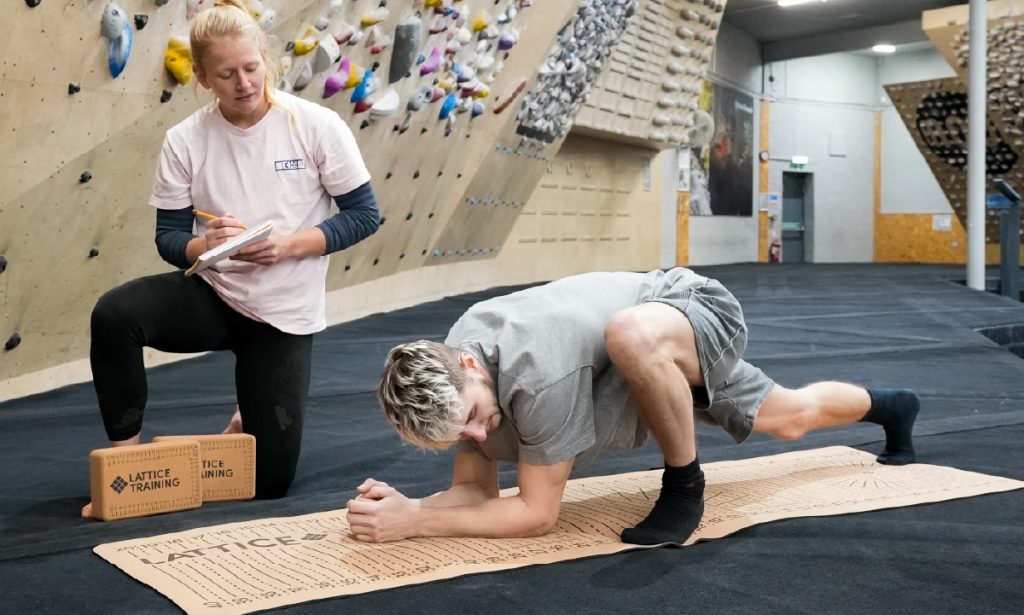 What we learnt was, what we then passed on to our coaching team and subsequently to all of the clients and athletes we worked with over the years. This was, that each climber is uniquely individual from any other, but underlying each person’s performance there are always a broad set of rules (training physiology), expectations (test data) and guidelines (training strategy). A great coaching and training plan is a combination of data/sports science, experience and know-how.
At the end of the day the universal truth remains: finger strength is the single, well-researched metric that most reliably predicts climbing grade. However the benchmarks should be gender-specific and ideally multi-factorial. Training plans that set the same absolute targets for everyone miss this crucial nuance - and that's exactly why Lattice assessments compare you to the right population, not just the overall average.
What about the press-ups and technique that I wrote about earlier? Don’t worry… I’ve got you covered. In any of our data where we find a weak correlation between the metric and climbing performance we do two things - and so can you. We don’t endlessly chase the metric itself - that’s a waste of time - and also we lean on sports science know-how. If we know that antagonist training has a benefit to climbing performance then we’ll still assign it in a training plan. It’s that simple. On the topic of technique then we really all have to be aware that as one of the key pillars of climbing performance this aspect is going to massively affect performance, just like finger strength. My advice to you is simple. Become a steely fingered climber and become an incredible technician.
Interested in improving your finger strength? A LatticePlan builds you a personalised hangboard program for YOU and YOUR goals. Try it free today.
Sample size: 6,000+ tested climbers
Comments (0)
Be the first to leave a comment.