Is pull-up training a waste of time for climbers?
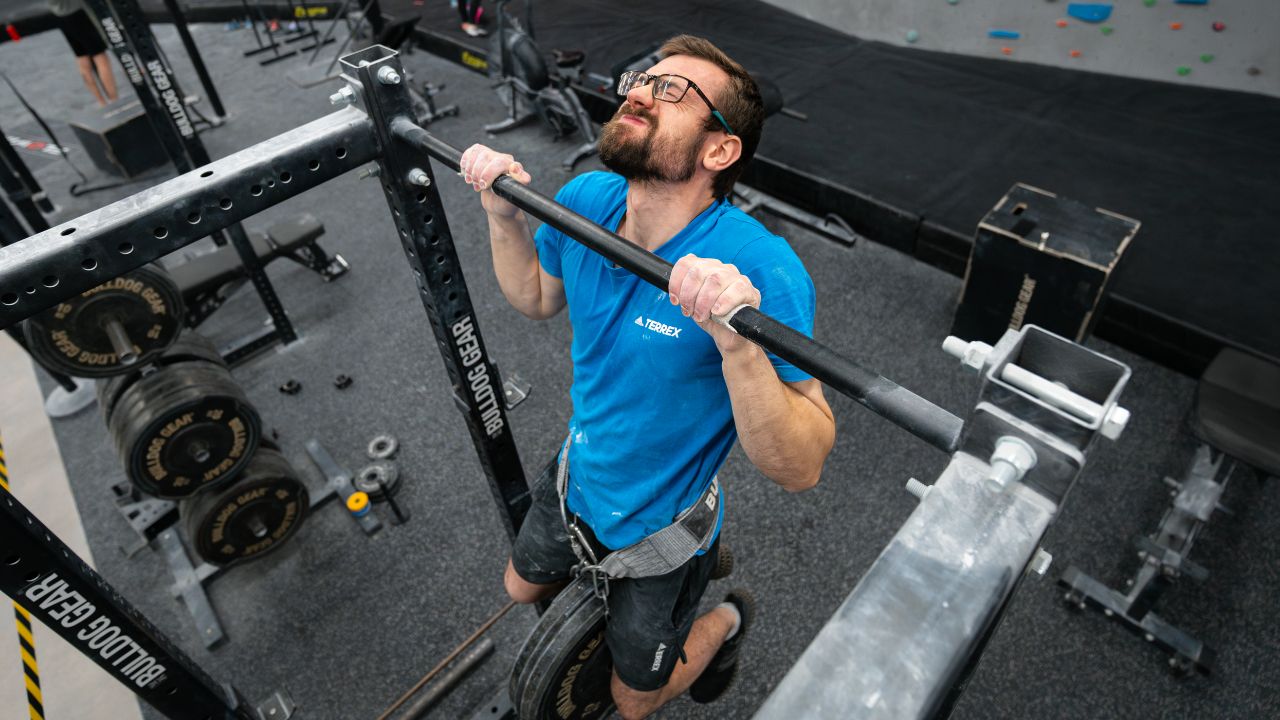
Will Bosi recently told us something that might surprise you. During a video shoot, he admitted he rarely does weighted pull-ups in training anymore. "I swear I only ever do pull-ups/weighted pull-ups when we film these Lattice videos," he said. Erin McNeice then said the same.
So naturally, we put them both to work on weighted pull-ups. Will pulled 180% of his bodyweight. Erin pulled 170%. For context, the gold standards we've published for years in our remote assessments are 165% for male climbers and 135% for female climbers. So Erin and Will are clearly past those thresholds.
So this raised an obvious question: if two of the best climbers in the world don't train weighted pull-ups, should you?
The answer depends on where you are in the grade spectrum - our data from 733 weighted pull-up 2-rep-max tests across Lattice elite assessments tells us a bit more…
At V7–V8, the average male climber pulls about 145% of bodyweight. By V9–V10 that jumps to 160% — a significant leap that coincides with the transition from advanced to elite climbing. But from V9 through V12, covering four full V-grades, the average barely moves: roughly a 2 percentage-point improvement across a range that represents years of dedicated climbing and training for 99% of the population.
Except at the very top…. (tbf there’s always interesting things going on up there!)
Here's the issue and the reason Will is mostly right rather than completely right to brush off heavy weighted pull-up training. At V14, the ratio jumps up again. The sample at that level is small, so treat it as indicative rather than definitive, but it suggests that at the outer limit of bouldering, raw pulling force may start to matter again. For the vast majority of climbers, though, the 165% plateau is what counts.
For those of you looking for training takeaways on this point - I’ll try and state it simply. If you’re below the gold standard on this particular performance metric, then having this as a regular focus in your training blocks is likely a good use of time. If you’re above it, then you need to look carefully. Are you aiming for V14 and beyond? Do your goals have extremely large moves or are you limited by upper body pulling strength rather than finger strength, flexibility or energy systems capacity? Most climbers - even the elite ones - will see better results when they first enter the top of the elite category by focusing more on the latter factors.
Why does the plateau happen? This is certainly a question I have asked myself over the years…
Pull-up strength has a ceiling of ‘usefulness’ let’s say. Below roughly 160–165% of bodyweight for men, pulling strength is likely a limiting your climbing, but not the only one. You may lack the force to execute powerful moves, lock off effectively, or control dynamic movement. Above that threshold, the returns diminish. You can see a parallel pattern in something really basic like side splits flexibility. Up to a point (around 100% of body height) the splits metrics translate well into climbing, but the ability to “full” splits is unlikely to unlock another grade.
The female data tells a parallel story.
Sample sizes are smaller, but the overall female average sits at 137% of bodyweight — almost exactly on the 135% gold standard. Female climbers operating above V10 tend to sit in the 135–155% range, with standout performers like Erin (170%) representing genuine outliers who built exceptional pulling strength as a byproduct of years of hard climbing, not as a direct training target. The pattern of diminishing returns is the same for both sexes; the thresholds are simply offset at ~165% for men, ~135% for women.
Elite climbers only have so much time to train, so the things they do have to count towards performance. Their years of hard bouldering, campus work and steep climbing maintain their pulling strength at or above the gold standard without ever targeting it directly. Whether you're elite or not, your exercise choice should be an intentional, well-thought-out one. The purpose of a session is not to get tired, to get pumped, or to flex at the gym. It's to improve, to adapt and to progress towards your goals. This means every exercise has to answer one question: will this affect your performance in the long run?
The practical takeaway.
Test your weighted pull-up! If you're below the gold standard for your gender (165% male, 135% female), there are genuine gains to be made. They'll likely translate directly to harder climbing. If you're at or above it, you've likely hit a ceiling of usefulness until you hit the super elite. Redirect that energy to where your next grade potential actually lives. For most climbers, that's finger strength, flexibility, endurance, or movement skills.
Want to know your numbers? Well, it’s what we’ve been doing for over 10 years at Lattice now. It’s how myself and Tom started out!
A full Lattice Assessment measures your weighted pull-up alongside finger strength, energy systems, flexibility and conditioning - a complete picture of where to invest your training time. Sign up for an assessment online (you can do this in your own time with equipment you’ll find in most commercial gyms) and find out whether pull-ups are still worth your time.
Comments (2)
 T
TTim
·
August 14, 2026
Great article & reminder of this training need, thanks
 MG
MGMattias Gönczi
·
August 17, 2026
Hi! It would be nice if these kinds of findings was followed by r² values or significance intervalls to se if it’s really worth the effort (saying that as I’m on the heavier side and plateauing quite a bit from that gold standard 😉 but at age 43.?? Or just keep doing the ~20 sets of max pull-ups for the slow gains)