Nutrition Research & Data

BMI and Climbing

It is well known that climbing (both bouldering and sport climbing) is a sport that is affected by power to weight ratios. The biggest factor that bodyweight affects is the percentage of bodyweight that we’re able to hang on a climbing hold – simply put, if you reduce body fat and retain lean muscle mass you’ll be able to hang poorer holds for longer.

For this reason there are many who have tried to reduce bodyweight as a method for increasing performance. Whilst we are objective enough to acknowledge that this can work in certain situations our data suggests that long term low BMI does not necessarily result in the best climbing performances.

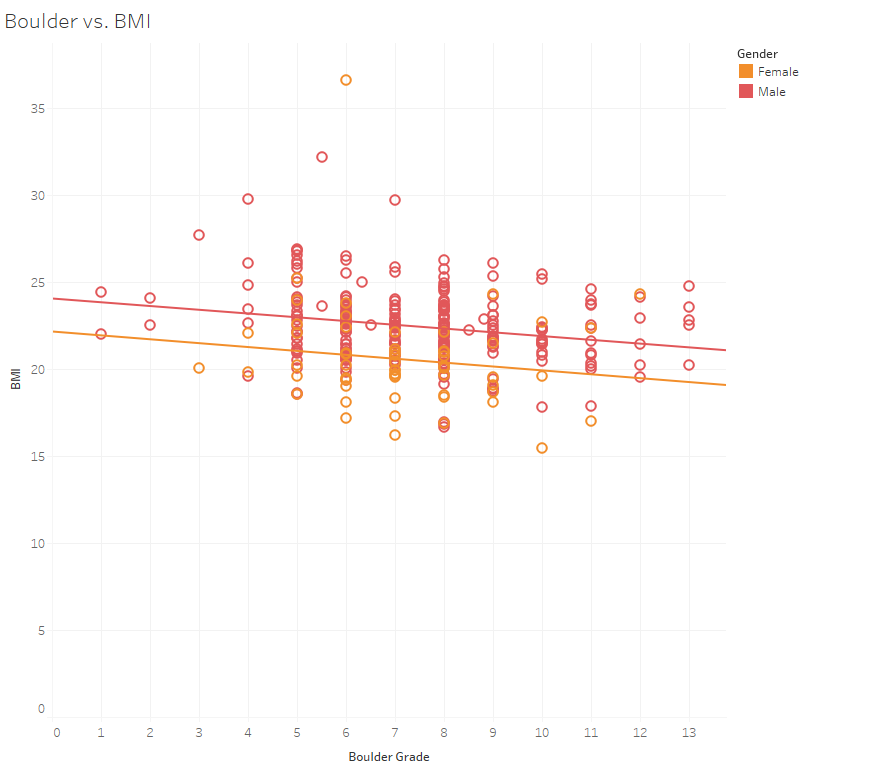
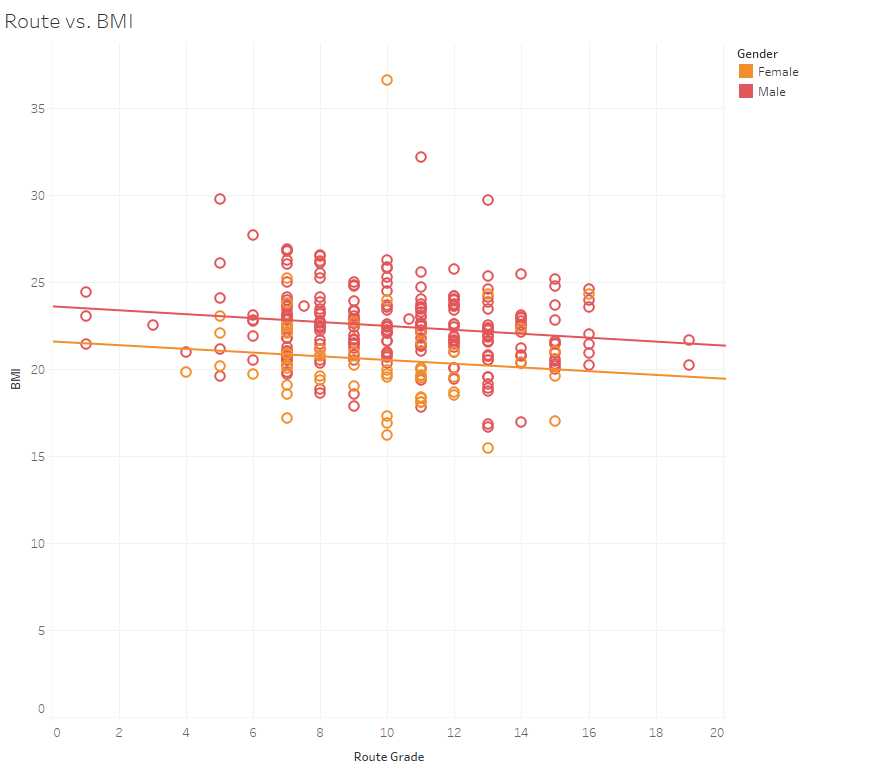
Below we have plotted the BMI against the max grade climbed in the preceding 2 years for every climber in our database.

While there is a slight negative correlation it is not substantial. Of greater note is that the line of best fit in all cases lies within the ‘healthy’ 18.5-24.9 range, this suggests that maintaining a low BMI is not necessary for climbing hard.

Note: this is a slightly expanded version of a facebook post.

Comments 11

  1. Matt 2 years ago
    Interesting dataset. I can’t help wondering if body fat percentage vs climbing grade would have a stronger correlation.
  2. Kasey 3 years ago
    Looking across individuals is interesting. Looking within would be more so, though much harder to get that data. After dropping 15 pounds in 4 months (2 BMI pts…wt from long covid and two pregnancies), my climbing has rapidly improved to a place where I recently flashed my red point.
  3. Andreas 3 years ago
    Hi, Do you have an updated plot of this data now that you have had many more people tested? Best, Andreas
    1. Tom Randall 3 years ago
      Yes we do! We've got some of the data on this being reported over the next few months (watch out on social media or our blog for this).
      1. Zack 3 years ago
        Thanks Tom! Look forward to this data! As a climber with a bmi of 30 but with a 31in waist, curious to see how the data plays out.
  4. Steven 4 years ago
    It seem to me to use "max grade climbed in the preceding 2 years" may not be the ideal thing to use, since presumably some boulders might not be impacted as much by BMI as others. It seems to me that slabs would be not nearly as impacted in comparison to overhang, for example.
  5. dominic 6 years ago
    I'd love to get technique tips from the outliers. I think it would be very interesting to see what helps them climb with extra weight, if you know who they are please look into it.
  6. Tom 8 years ago
    Hello, I looked up this page after listening to the trainingbeta interview and was made aware by my partner that there may be some confusion in the interpretation of the data with regard to inter and intra individual variability? It may be correct that low bmi does not translate to better individual climbing performance but that does not seem to be an assumption that can be made with the data (inter individual) that was presented..? Having said that I agree though that an emphasis on maintaining a healthy bmi and body weight is important in our supervision of young athletes.
    1. Remus Knowles 8 years ago
      Hi Tom, as you say it is important to note that the analysis presented above is inter-individual, and as you say correlations between an individuals bodyweight and climbing performance are not explored. In my opinion, the main message is that maintaining a consistently low BMI does not appear to be an indicator of climbing performance.
  7. Byron Hempel 8 years ago
    For us silly Americans, on the Routes vs BMI graph, what does the x axis correlate to in the YDS? I.e. a grade of 10 = what grade in YDS?
    1. Remus Knowles 8 years ago
      Hi Bryon, the x-axis is a straight map of french sport grades to numbers. 7a = 7, 7a+ = 8, 7b = 9, ... Looking at a grade conversion chart, 7 ~= 11d, 8 ~= 12a, 9 ~= 12b etc. Boulder grades are just the numerical part of the V grade. i.e. V5 = 5, V6 = 6 etc. Thanks Remus

Our Training Plans

LatticePlan

  • Perfect for all disciplines
  • Self-Led
  • Focused on overall performance
  • Access to Lattice app
  • Adapts as your train
Learn more

Climbing Training Plan PLUS

  • Written by an expert coach
  • Coach support via in-app chat
  • Perfect for all disciplines
  • Focused on overall performance
  • Access to Lattice app
  • Unlimited plan edits
  • Exclusive discounts + offers
Learn more